Saturday, January 1, 2011

Resolutions for 2011

I hadn't really thought of any resolutions for this year, and I wasn't planning to do any, but a few ideas came to me earlier today, so I thought it would be good to write them down:

1. Focus on my own faults and overlook others. The only things I can change are my own bad qualities, so why waste time pointing out others'?

2. See God in every person and act accordingly. Each person holds God within him- or herself, and I need to remember that constantly.

3. Write in my journal at least once a week.

4. Work out at least once a week.

5. Be less quick to anger and indignation and be more patient, loving, and tolerant. Give others, and the world, the benefit of the doubt.

6. Be more decisive.

7. Recite one of the many slokas I know once a week. It's not that hard. Do it.

8. Be more productive.

9. Read this every day to remind myself of my goals.

Here's to a year worth remembering, complete with [at least] two weddings (one for my sister, another for one of my oldest friends and college roommate), the end of my basic sciences curriculum in medical school, and my last real summer break.

Thursday, November 25, 2010

Thanksgiving

I love that the one holiday that is truly American is Thanksgiving. What a lovely concept encapsulated in just one word: giving thanks.

Let me be honest about something: I don't love the holidays the way most people do. I'm in that somewhat pitiful minority of the population that dreads the holidays because they inevitably bring with them filial strife. There is nothing intrinsically festive about the Christmas season for my family, and trying to bring a holiday spirit into the house during that time sometimes feels a bit forced, even futile. Layers of issues emerge during this time, not least of them the difficulty of being an immigrant family. So I always tiptoe around the holidays, because I never know what they will bring. One day the family could get along wonderfully. The next we could frown at one another terribly.

Let me be honest about another thing: it's been a tough year. I've cried a lot, questioned a lot of things I've taken for granted all my life, and had really high ups and really deep downs.

And yet.

I still want to give thanks. So here goes:
I'm thankful for my friends, who have proven their incredible worth to such a degree that I cannot begin to express my gratitude. I'm thankful for the family that could only cause me so much heartache because they have given me so much love. I'm thankful for college and all that it has taught me. I'm thankful for the words that help me make sense of this world. I'm thankful for the music that has so often been my loyal companion. I'm thankful for critical thinking. I'm thankful for being a medical student, difficult as the road may get. I'm thankful that despite legions of unhappiness, I am still surrounded by joy that can't be kept down. I'm thankful. And I'm glad there's a holiday that reminds me to take a moment, or a day, or a week, to give thanks for all that is good in my life, because there is so much. What are you thankful for today?

Wednesday, October 20, 2010

Selection Bias

I've been playing my iTunes on shuffle for the past three days, and I've been continually impressed with just how good the playlist has been. Owl City and Ingrid Michaelson and Imogen Heap and Kate Nash and Hellogoodbye and some great Tamil songs thrown in, along with some of the new Maroon 5 album. It made me really happy that such great songs were coming up on shuffle.
...
And then I realized that I'm loving all the songs that are coming up because they're, well, my library. Selection bias works its magic: I chose all the songs that went into my iTunes library, so of course a random playlist of them would be filled with all my favorites. It ruins the magic a tiny bit, but it also makes me smile. How circular our lives can be.

Another example of selection bias: patients on peritoneal dialysis are more likely to survive than those on hemodialysis, even though peritoneal dialysis is less effective at renal clearance than hemodialysis. Why, you ask? Well, because of many factors, including better retention of renal function in those on peritoneal dialysis, the lack of biocompatibility issues for peritoneal dialysis [unlike the ones rampant in hemodialysis], more cardiovascular complications on hemodialysis, and better clearance of middle molecules [which may be toxic to dialysis patients in the long run] in peritoneal dialysis. But most importantly, patients on PD might have a selection bias phenomenon: those who choose to do the more independent and demanding form of dialysis are likely to be better-educated (and thus take better care of their renal health overall), less sick, and have better family support.

^I wrote that entire paragraph to review something I studied today. Exams start in 6 days, and it's time for lockdown. Not long till I see the light!

Thursday, September 23, 2010

Ostrich

Every once in a while I get to acting like an ostrich with its head in the sand. I get ensconced in my routine, used to the way I run my life, and fail to reach out and grab the chances offered to me. Meetings of interesting organizations go unattended, simple surveys unfilled, because I'm just used to the way I've settled into things, because Grey's Anatomy is on and I don't want to miss it. It's a ridiculous and infuriating tendency in me, this love of sitting back and relaxing. Life would be better if I were always on my toes, at the edge of my seat. When I was finishing college, I realized that though it might seem on paper that my hand was always in something or other (metaphorically, not literally), I really didn't do nearly as much as I could have or should have or might have.
Because of that realization, and because I don't want to have regrets when I graduate from medical school, I'm trying to live with the concept of doing more than you think you can. Like Imogen Heap sings in Tidal, I want to "do it for all the times we wished we had." And that means stretch myself academically, extra-curricularly, socially, and with new experiences. I've been doing all right so far, and it was especially easy to stretch myself out of some comfort zones while medical school was still new and fresh and I hadn't yet settled into a routine, but I'm finding myself edging towards that dangerous complacency now, and I want to avoid it.

Also like an ostrich with its head in the sand, I can be completely clueless sometimes. Case in point: this evening around 9:30 I realized that I had failed to attend the FIRST SESSION of an elective this afternoon. I was really excited about this elective, too: Art of the Human Body at the Museum of Fine Arts. But instead of going to it like a responsible student, I completely. Forgot. Instead, I took a two-hour nap this afternoon (glorious, but not exactly productive), studied some, cooked a tiny bit, and watched two premieres of two shows. I'm not saying it wasn't a good day overall. I'm just saying I need to get my head out of the sand (or my ass, or my routine) and take a look around every once in a while, because I miss important things when I get this way.

Monday, September 20, 2010

The Good, the Bad, the Ugly

The Best: I met Amy Tan tonight! I love her books, though I haven't touched one in ages, and I didn't even get to hear her read because I had to leave early, but meeting her was such an honor, and I got her to sign my yellowed paperback copy of The Joy Luck Club and take a picture with my sister and me. All in all a pretty great Monday night.

The Great:
1. I went to a reading last Tuesday evening by my wonderful former creative writing professor, Emily Fox Gordon (www.emilyfoxgordon.com). She is one of the most intelligent authors I've ever read--in my adult life, other than when reading, say Moby-Dick or Midnight's Children, never have I had to look up words so many times while reading a book. Emily's cadences are nearly always spot-on, and I am so proud to have been taught by her. She struggled with trying to write fiction for many many years before realizing that personal essay was the genre for her (and, I think, the genre for me--this is the class I took with her), but she had to write two memoirs and one novel (the last a triumph for her, because she never thought she could write fiction) before FINALLY getting to publish a collection of her personal essays entitled Book of Days. I bought this book at her reading and had her sign it, and she signed it "To Chaya, one of my very favorites," which made me feel really special. I'm hoping to have lunch or coffee with her some time in the near future. That reading came at the perfect time: between my first medical school exams. It reminded me that there's a whole other amazing and happy side to me and my life that isn't sciencesciencescience, and I had nearly forgotten about that aspect. So it was just. Great.

2. I've realized that I can count on my best friends to see through my facades and know exactly, exactly when I need them and to be there when I need them, and that is comforting in a way I cannot even express. I don't know what I'd do without the wonderful people I have in my life.

The Good:
1. I've made soup twice since moving into my apartment, and both times, the soup has come out great. Really, great. This is absolutely wonderful, partly because I love soup, but also because I've always, always wanted to be a wonderful recipe-less cook like my mother, and I'm finally starting to edge towards the possibility of that. I've eaten tons of sub-standard Indian food (prepared by myself) for the past few years as I've tried to find my cooking rhythm, and I'm finally starting to get that magical intuition that all Indian mothers seem to have. And my newfound cooking savvy seems to extend to pastas and soups as well! This is wonderful news.

2. I'm one block into medical school, and I've not only made it so far, but enjoyed it. I'm a little loath to begin studying again now that a new block has begun, but I'm hoping that my enthusiasm will grow slowly but surely.

3. The new Sara Bareilles album is filling me with great joy. How wonderful when an artist one loves proves her worth with a second album that is quite possibly better than the last.

The Bad:
1. It's 9:10 PM and I've only reviewed one of the four lectures I had today. And I wanted to go to bed early tonight as getting up early (after four days of vacation) was particularly difficult this morning.

2. Crazy as it sounds, medical school is the simplest, most manageable thing in my life right now. On the one hand, this makes medical school not so bad. On the other hand, it shows how much of a struggle many other things are being right now.

The Ugly:
1. I'm trying to write a piece for my medical school's literary magazine, and I'm running into problems from the outset. I haven't written anything worth anyone else's revisions in an incredibly long time, and I really want to make this piece great, because I know there's substance there. I just feel like the lolcat in that lolcatz picture, the one that's sprawled across a keyboard with the caption "Writer's block. I haz it."

2. I just want so badly to be substantive, real. I feel that I'm not really either.

Wednesday, September 1, 2010

Like a Duck to Water

Crazy as it may sound, that's the way I feel that I've taken to medical school. To be perfectly honest, I wondered for a long time whether medical school was the right path for me, even as I was interviewing and deciding where to go to school. Once I got here, though. I quickly [very quickly] learned that it was exactly where I wanted to be, where I was supposed to be. Perhaps it's just the excited flush of new experiences and new friends, or the joy of learning, or the even greater joy of finally starting on the path toward my chosen career, but medical school, though challenging no doubt, is proving to be much, much better than I had anticipated.

I've been taking classes for five weeks now (our orientation was six weeks ago), and it feels like forever. I barely have a memory of the summer that was before school began. We've covered in five weeks what a college course would have covered in at least 2/3 of a semester, encompassing two tests or more. And we still have one more week of classes before we finally have an exam over our first "block" of material.

When I was still in college [now that's a weird clause; I graduated from college almost a year ago. Imagine that!], I heard from a lot of friends in med school that trying to study all the information thrown at you is "like trying to take a sip of water from a fire hose." It's hard to actualize that kind of workload until you're experiencing it for yourself, but I'll have to say that the simile is quite apropos. I would like to add one of my own, though: each week, I feel as if I'm stuffing more and more compressible cotton balls (information) into a container with a snap-shut lid (my brain). As the weeks go by, the volume of the container gets more and more filled, and each week I'm having to push the cotton balls down, compress them as much as possible, then pull my pressing hand away as rapidly as possible as I rush to snap the lid shut on those overflowing cotton balls. It's a set of expectations the sort to which I've never had to rise before, and it's not easy.

But.

I'm finding that I actually like learning about feedback regulation in glycolysis, the muscle that makes my knee jerk in that famous reflex, the tendons visible beneath the skin of my hands. I like my classmates. Their intelligence, while a bit intimidating, is inspirational. Medical genetics and embryology, basically classes about every way a human being's development can go wrong, make me grateful that my genes contain no deleterious mutations, that the oddly-named Sonic Hedgehog signaling protein was present in all the right places and in all the right amounts so that my neural tube developed properly less than three weeks after my conception. There is so. much. to learn about our bodies, but how amazing to know how our muscles contract, that there are tiny little fibers that "walk" across each other every time our motor neurons fire and excite a skeletal muscle? Every time I get to thinking that this is just too much, that no one person can do this, I try to remind myself that so many others have gone before me, so it's possible. More importantly, one day I could be taking care of someone's motherfathersisterbrotherfriendhusbandwifechild, and I want to know everything I can so that I can take the best possible care of that person.

And it doesn't hurt that I still have time and energy to go out with friends on the weekends, talk to my roommate about our respective days daily, see friends from college, visit my family back home, and, yes, waste time every once in a while. More often than I probably should, in fact.

I've been watching Saved by the Bell in the mornings while I'm eating breakfast before school, and I can't help thinking that the theme for "The College Years" episodes is rather relevant to my current situation: "I'm standing at the edge of tomorrow...the future looks bright to me." I am so excited to be starting this next stage of my life, and I can't wait to be a real MD, with all the knowledge--and responsibility--that entails. Not to mention, it'll be nice to finally be getting paid.

"We're young enough to say, 'Oh, this is gonna be the good life.'" Good Life-OneRepublic

Tuesday, June 22, 2010

A Primer on South Indian Temples

Finally continuing with my "Coming Attractions," i.e. blog posts about my time in India, I present to you pictures and information about what is probably my favorite part of going to India: visiting temples.

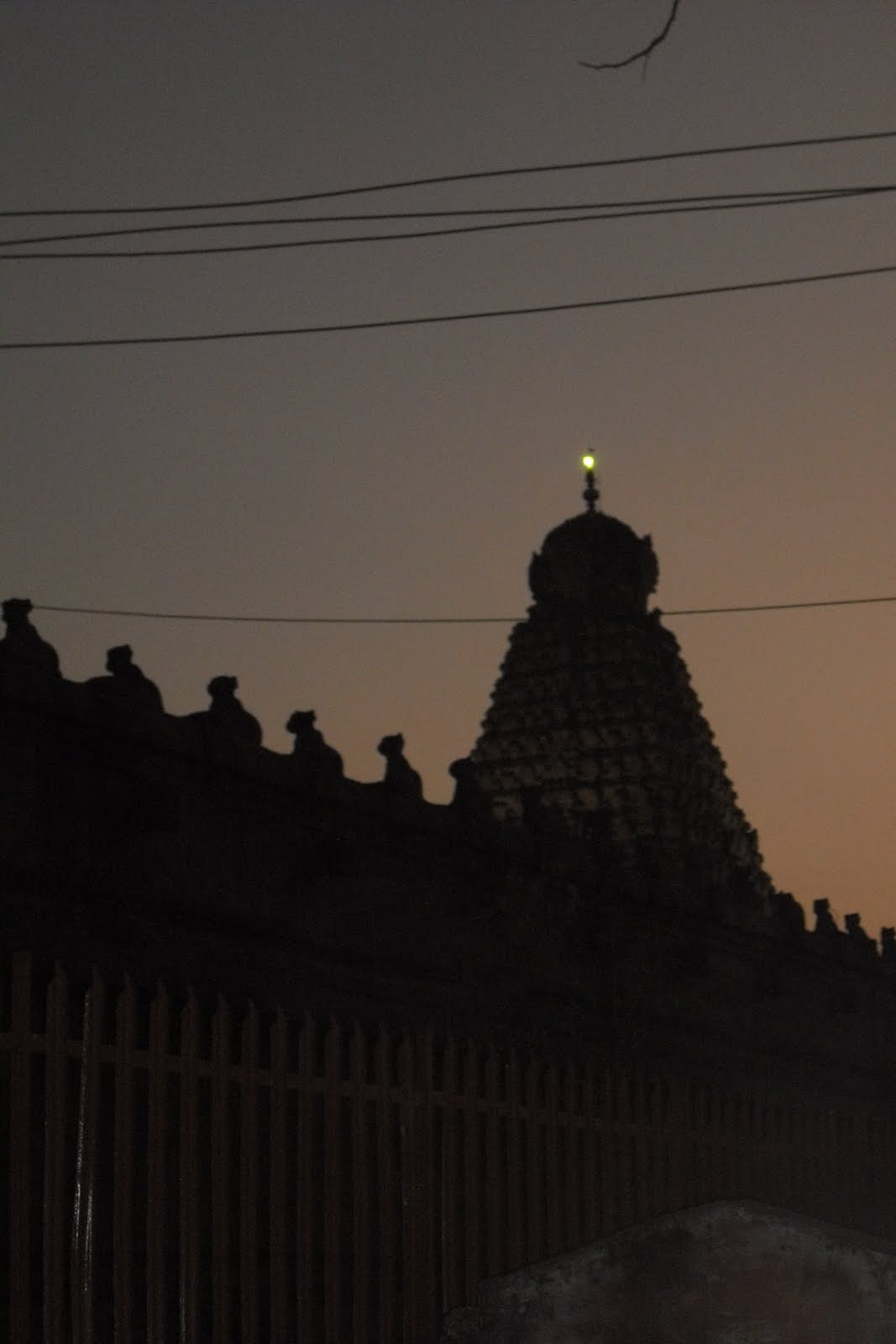
Let's start with the Brihadeeswarar Temple in Thanjavur, often known as the Big Temple. This is my temple in more way than one. Located in the town where I was born, this is the temple where I feel most at home in India. Its main tower, or gopuram, is impressively tall (216 feet, according to Wikipedia [http://en.wikipedia.org/wiki/Brihadeeswarar_Temple]), and it is the world's first complete granite temple, also according to Wikipedia. Both facts make it literally an architectural marvel. Commissioned by King Rajaraja Chola in 1002 AD, the temple is celebrating its millenial year in 2010.

Brihadeeswarar is the name of the form of Lord Shiva worshiped at the Big Temple, making the temple a Shiva temple (as opposed to a Vishnu temple, as you'll see later). Small Nandi statues line the outer perimeter of the temple grounds, as seen below:


Legend has it that the shadow of the gopuram never falls on the ground, falling only upon the tower itself--that's how tall it is. There is a tree behind the gopuram upon which a number of highly camouflaged lizards live. Legend also has it that if you can find a lizard on that tree with your naked eye, whatever you prayed for at the temple will be granted. This is the temple where I had my first and only ride on an elephant (it was a baby, and had prickly hairs on its back; did you know that elephants had hairs on their backs? I certainly didn't until I rode that one). This is the temple where my alternate name, Brihadaambal, comes from. [As per the tradition of my mother's family, girls are given unofficial names borrowed from a goddess worshiped in their hometowns to commemorate their birthplace. Brihadaambal is the name of Brihadeeswarar's consort, and her sanctum stands to the right of the main tower in the Big Temple.]

I love the history of this temple, the very smell and sound of it. For its size alone, it is not to be missed on a tour of temples in the South of India.

Here's one last picture, just to show the two massive gates that stand before the actual temple grounds:


With my great-aunt and great-uncle, I visited a number of temples in the villages surrounding Thanjavur while I was staying with my mother's family. Here are some shots I took in Mellatore, the ancestral village of one of my great-grandfathers, though for the life of me I couldn't tell you which one:

Above is a Vishnu temple (indicated by the chakram, naamam, and sangu sculptures on top of the stone awning) located at the end of the street where my great-grandfather lived with his family. Notice how this temple is brightly painted, whereas the Big Temple is the natural color of stone. I used to think that painting temples in bright colors was a recent phenomenon, but I think that most temples, ancient or otherwise, start out brightly painted, but the paint wears off with time, hence the color of most ancient temples--unless they've been recently renovated, as some have. Notice also the vertical white and red stripes that line the bottom of the temple structure. You'll see these on many temples and temple walls in South India. I have no idea why they're painted in this fashion, but they are.


This is a beautiful kolam I saw on the floor inside the Vishnu temple pictured above. A kolam is an intricate dot-and-line design drawn with rice flour on the ground for ritualistic and religious purposes. There are a number of standard kolam designs. They are made out of rice flour so that ants can eat them, or so my mother has once told me. I've been trying to learn how to drawkolams this summer, and it is not easy to draw out lines of rice flour with your bare fingers, let me tell you. The person who drew the one above is very skilled indeed.


I saw the above instrumentalists (the first playing the naadaswaram, a sort of Indian oboe, and the second playing a type of drum, the name of which I don't know) in front of a Ganesh temple in this same village. They were playing because an upanayanam, or sacred thread ceremony (a coming-of-age ceremony for males) was occurring inside the temple. You'll see instrumentalists like this, or at least hear recordings of their music, at south Indian weddings and other religious events.

Next on my temple tour was the Panchanadeeswarar Temple in Thiruvaiyaaru (literally, five holy rivers; my great-uncle told me this name came about because you cross five tributaries of the holy River Kaveri on the road to this town from Thanjavur):

The name of the deity worshiped here, a form of Lord Shiva, means Lord (Eeswar) of five (Pancha) rivers (Nadi). To the left of the frame is the main tower, or gopuram. Within the bounds of the yellow stone wall on the right of the frame is the large temple moat or well. Many temples have their own sources of water built onto the grounds. I'm not sure if the temples use the water in those moats anymore, but the moats still exist. The stone ground at this temple was searing hot even in February. I remember its being unbearable during previous trips here in the summertime. The idols of the God and Goddess at this temple are big and quite beautiful.

One of the things I liked most about this temple were the paintings (would it be correct to call them frescoes?) painted on the inside of the perimeter walls. I saw them while doing the ritual circumambulation (pradakshanam) of the temple. Aren't they beautiful?


On the same day, we also visited the resting place (samaathi) of the composer-saint Sri Thyagaraja, who composed many (many) famous and lovely Carnatic songs in his day. His resting place is located right on the banks of the aforementioned holy River Kaveri. Like in other ancient societies, bodies of water are highly revered in the Indian culture. Rivers are most often personified as female deities, and washing one's feet or body in the waters of any holy river, the Kaveri included, is said to cleanse one of one's sins. I'm not sure if I had ever done this before, though I'm thinking I probably had, but since we were so close to the river, my great-aunt and I walked the few steps down to the water and bathed our feet. It was pretty cool.
You can see the river just past the tree and the kids playing on the sandy ground. Those kids would later ask for water from my bottle and then proceed to pass the bottle around, nearly depleting me of my precious mineral water. They were pretty cute though, so I guess it was okay. You can also see the silhouette of my great-uncle in the right foreground of the photo. He has hairy ears, which I find highly amusing.

My mother was born in Thiruvaiyaaru and my uncle works in a school there now, making it yet another town to which my family is connected.

Leaving the greatest connection for the last, we come to Thirupponthuruthi (it's a mouthful, I know), where my mother grew up, and where I believe her fondest memories were made. This place is very much still a village, with picturesque palm trees everywhere and humble homes lining the narrow streets. There are a few things I don't like about the village, the lack of soap in public restrooms for instance, but it's quite a pleasant place, and has a number of temples as well. The only one I visited was the local Shiva temple. I'm not sure what the name of this particular deity is, unfortunately, but here are a few shots of the temple.
This is a mirrored, gold-plated, and jeweled palanquin used to convey miniature idols of the deities for temple ceremonies that involve parades. I thought it was beautiful.
My favorite part of this temple is the story associated with it. You'll notice a small yellow shelter in front of the main tower in the picture above. This shelter contains an idol of the bull Nandi, who is Shiva's vehicle--this is the same Nandi that lines Shiva temple walls. Normally, the Nandi shelter is located directly in front of the door to the temple, so that the Lord is always in Nandi's line of sight. However, you'll notice that the shelter is shifted slightly to the left in this photo.
Here's the cool story: legend has it that a great Shiva devotee came to the outer gate of this temple and began singing the Lord's praise. I'm not sure why, but he never entered the temple itself, so he was singing the entire time without a glimpse of the idol--and in Hindu culture, being able to see the idol is an important part of devotion. Seeing the deep faith of the devotee, Nandi Himself animated the statue of Nandi and shifted it to the left of the door, providing the Shiva devotee with a clear sight of the Lord. This is supposedly the only temple you'll ever see where Nandi is not located directly in front of Lord Shiva. Cool stuff.

I apologize for the length of this post, but as you can see, I really love the subject matter. I've visited many other temples during my multiple trips to India, but this was the first trip during which I made a conscious effort to remember all the things I saw and learned. I hope this post was educational and interesting and not boring!